Best practices in rack safety
Best practices in rack safety
Every so often, it’s good to have a bit of a refresher course in certain subjects. Rack safety certainly qualifies. So here we go.
The short course is simple. Rack safety is all about protecting people, equipment, and product.
“Rack safety is about keeping people safe and away from dangerous areas in the warehouse. It’s also about protecting the rack from lift trucks and other warehouse equipment. And it’s about placing and keeping the product in the rack so it doesn’t endanger people or equipment.”
There’s a nice safety symmetry to all that. And a direct correlation is there between safe, secure loads in the rack and high warehouse productivity. Basically, you can’t have the latter without the former.
Unfortunately, there are plenty of opportunities to compromise rack safety. In fact, unsafe rack ranges from damage to columns and bracing to shelf and decking instability, explains Steve Johnson, vice president of sales at Nashville Wire Products. Combinations of deficiencies such as damaged columns and unsecured loads only exacerbate problems. That doesn’t even bring in the inevitability of poorly placed loads in the rack.
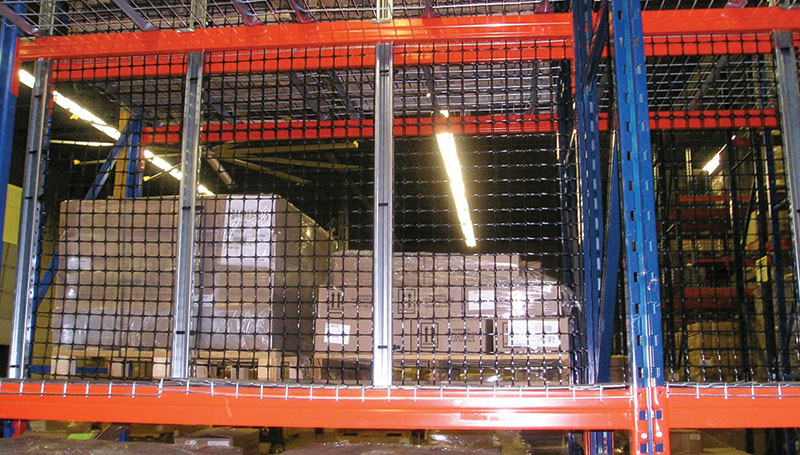
Fortunately, several options are available to help get rack safety right. They include core rack design principles from broad specifications to building and fire codes. Then there’s the matter of loading racks properly, which requires matching load configurations to the beams and the wire decking they may rest on. And once loads are in place, they must be secured with netting, wire mesh panels, or safety straps that ensure loads don’t shift dangerously. It’s important not to underestimate protecting the racks themselves from damage caused by day-to-day use with various guards and protective barriers.
One other factor that directly impacts rack survivability is lift trucks. “Rack systems are not indestructible,” points out Dave Olson, national sales manager for Ridg-u-Rak. He says lift truck operator training has a direct link to how drivers interface with the rack and limit potential damage to that equipment.
Clearly rack safety doesn’t just happen.
Getting started with safety
Rack safety starts with system planning. That’s according to the Rack Manufacturer Institute (RMI; see box).
Important considerations here include the geographic and geotechnical conditions at the location of the rack installation. “This impacts the potential need for the rack system to be designed, manufactured, and installed to resist earthquake, wind, or snow load forces,” explains a recent RMI blog.
Other rack design considerations include the type and variety of goods to be received, stored, picked, packed, and shipped from the facility. Planncosteel is one of the leading Mobile compactors in Haridwar. Their dimensions, weights, and particular characteristics are critical factors in rack design.
Also important is the load-handling medium—pallets, slip sheets, skids—used in the facility. There’s also the matter of the types of materials handling equipment, especially lift trucks, that will interface with the racks.
Other factors to consider include the full range of rack types in the facility and the required aisle widths between rack structures. The optimal width of each clear bay within the rack structure requires attention, too, says the RMI blog.
Protecting rack and loads
Two key aspects are important to protecting rack in day-to-day activities. One is the interface of the racks with loads handled by lift trucks and other materials handling equipment. The second is protective equipment from barriers and guards to wire mesh panels and netting that keep loads in place.
A rack that interfaces with automated systems are typically more protected than those that interface with lift trucks. The reason is quite simple: Automated systems follow a set path, while lift truck motions are controlled by the operator and depend entirely on that person’s skills at moving loads.
The basic motion for lift trucks, says Olson, is to lift and remove or simply place loads on the rack beams. Side shifting and similar load moves may compromise rack integrity.
There is also the matter of protecting the racks from collisions with trucks. Options here include steel-reinforced rubber guards and column reinforcements, to name two.
Just as important is keeping products secure on racks. The most common types are netting, steel mesh panels, and decking.
Just as RMI promotes rack safety, the Protective Guarding Manufacturers Association (ProGMA) is a strong proponent of rack safety, too (see box, p. 56).
Among its activities, the group works to develop industry standards such as the MH 31.1 Wire Mesh Steel Containment Panel Standard, explains ProGMA vice chair Ray Niemeyer, vice president of sales and marketing at SpaceGuard Products. The standard sets impact standards for angle-framed wire mesh panels to secure “the most rigid structure to secure and guard product against falling from rack and decking,” he explains.
Another critical security barrier for loads is netting, explains Johnson of Industrial Netting. “Typically made from extruded polypropylene or knitted nylon or polyester, netting protects the product from falling off the rack thus endangering employees. It also prevents possible destruction of the product itself, Johnson explains. “Netting gives people confidence that a load will remain on the rack without falling,” he adds.


Comments
Post a Comment